In this guide
The first diligence task is to connect the proposed agreement to the organization that will perform each service. A brand, a sales contact, a platform name and a certified legal entity can describe different parts of the same relationship. Put them on separate lines before treating a badge as evidence.
The IRS active CPEO list with report date August 7, 2026 names Resourcing Edge 2, LLC and Resourcing Edge 3, LLC with October 1, 2017 effective dates, and Resourcing Edge I, LLC with a January 1, 2017 effective date, on page 6. That establishes what this dated list contains. It does not identify the entity in your proposal or certify every business using the brand.
Build the chain in the right order
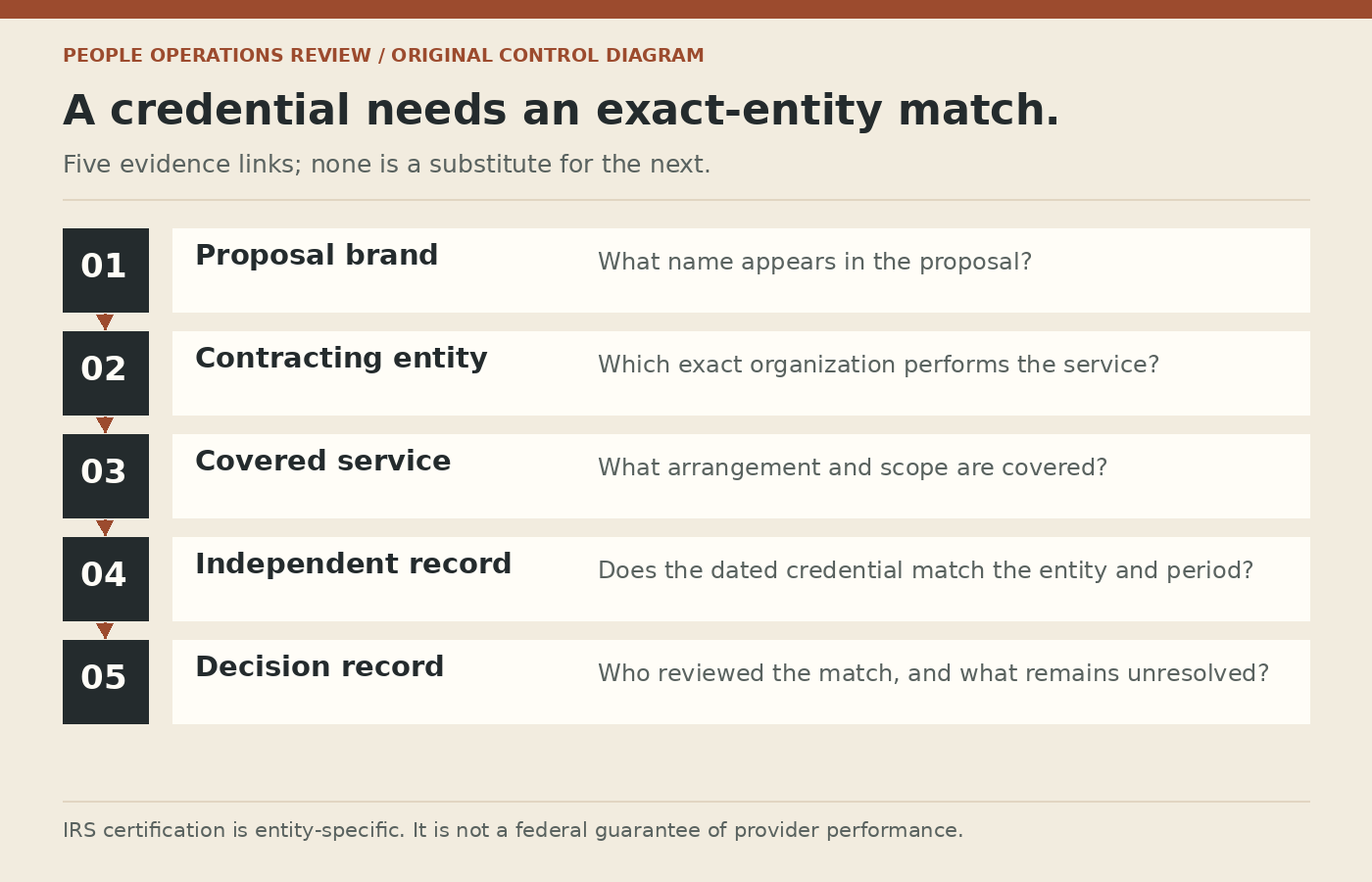
- Extract the contracting name. Ask the provider to identify the entity performing the relevant service in the final agreement, including any applicable schedules.
- Separate the service models. Note whether the proposed work is a PEO arrangement, administrative services or another payroll relationship. The same company may describe more than one offering.
- Check the independent record. For a claimed CPEO, use the IRS public listings, including the suspension and revocation resources, rather than an old sales attachment alone.
- Record the match and its limits. Save the source date, your actual check date, the exact spelling and the unresolved difference, if any. Keep sensitive identifiers in your authorized contract repository.
The IRS customer guidance says a CPEO contract must contain the exact name and EIN of the CPEO fulfilling its covered federal employment-tax obligations. This publication does not request that identifier or review a reader’s private contract. Your authorized reviewer can make the comparison internally.
Keep credentials in their own lanes
| Evidence offered | What to verify | What it does not establish |
|---|---|---|
| CPEO status | Exact entity, effective period and applicable arrangement | Government guarantee of business performance or every employment obligation |
| ESAC accreditation | Current accreditation and actual assurance terms for the entity | FDIC deposit insurance or unlimited reimbursement |
| Audit report | Report type, system boundary, period and exceptions | Every affiliate, every product or the absence of future incidents |
| Company service page | What the company publicly advertises | Your signed scope, staffing assignment or service deadline |
The IRS program explanation describes certification requirements including financial reporting, tax compliance and bonding. It does not create a federal performance guarantee. ESAC describes its own accreditation and financial assurance program; ESAC is not the FDIC. Ask for the controlling program terms rather than converting a marketing analogy into insurance coverage.
A fictional mismatch worth stopping for
Imagine a proposal cover says “Example Workforce Group,” an attached credential names “Example Workforce II, LLC,” and the agreement names “Example Administrative Services, Inc.” These invented names do not show a defect by themselves. They show an unanswered question: which entity is responsible for which service, and why does the supplied credential apply?
A useful response is a written cross-reference from the provider, reviewed against the agreement and independent record. An unhelpful response is a verbal assurance that all companies are part of the same group. Ownership can explain a relationship without making one entity’s status transferable to another.
Handle the platform discrepancy explicitly
On our check date, the Resourcing Edge homepage named PrismONE and older PrismHR routes, while OneDigital’s PEO page still described re360. Public pages therefore do not support one universal current interface. Record the platform assigned to your organization and obtain implementation material for that assignment. Do not build training or access approvals from a search result’s product name.
Close the diligence record with a decision: matched and documented; clarified but awaiting final agreement; or unresolved. Name who can accept the remaining uncertainty. Recheck material credentials before signing or renewing, rather than treating this article’s review date as a standing verification of your relationship. Then turn the verified scope into a responsibility map.
Give the decision file a shelf life
A dated credential record should explain when it needs another check. Renewal is one trigger, but so are a changed contracting entity, a newly added service or a material restructuring disclosed by the provider. The control is not a promise of continuous monitoring; it is a named owner and a defined occasion to revisit evidence.
Separate the source observation from the decision. “The list reviewed on this date contains this name” is an observation. “Our proposed contract is covered by the claimed status” is a conclusion that needs the actual agreement and appropriate review. Saving both statements prevents a later reader from mistaking a public-list screenshot for a complete contract analysis.
Keep a short question register for material gaps. Each entry should say what is unknown, which party can answer, what evidence is expected and whether the gap blocks the decision. A dozen minor unanswered questions should not obscure one unresolved entity mismatch. Conversely, an exact name match should not be used to mark pricing, coverage or security diligence complete.