In this guide
An operating map names who supplies an input, who performs the work, who checks the output, what proves completion and where an exception goes. It accompanies the agreement; it does not rewrite it. The map is most useful when both parties can point to the same version while a payroll or benefit deadline is approaching.
Resourcing Edge publicly describes payroll and HR services. A service heading such as payroll administration does not, by itself, identify the person who approves a changed rate or resolves a rejected item. Those are the gaps this original worksheet is designed to expose.
Use a verb for every assignment
A cell that says “shared” usually needs another pass. Shared accountability may be real, but the operational steps can still be precise: the manager submits; HR validates authority; payroll enters; the designated approver accepts; the provider processes; finance reconciles. Your actual sequence may differ. What matters is that a specific role can act and the next role can recognize the handoff.
Use role names rather than only individual names so a staffing change does not invalidate the whole map. Maintain current named contacts and backups in a restricted internal directory. Give each row an effective date, the contract or procedure it depends on and an owner responsible for keeping it current.
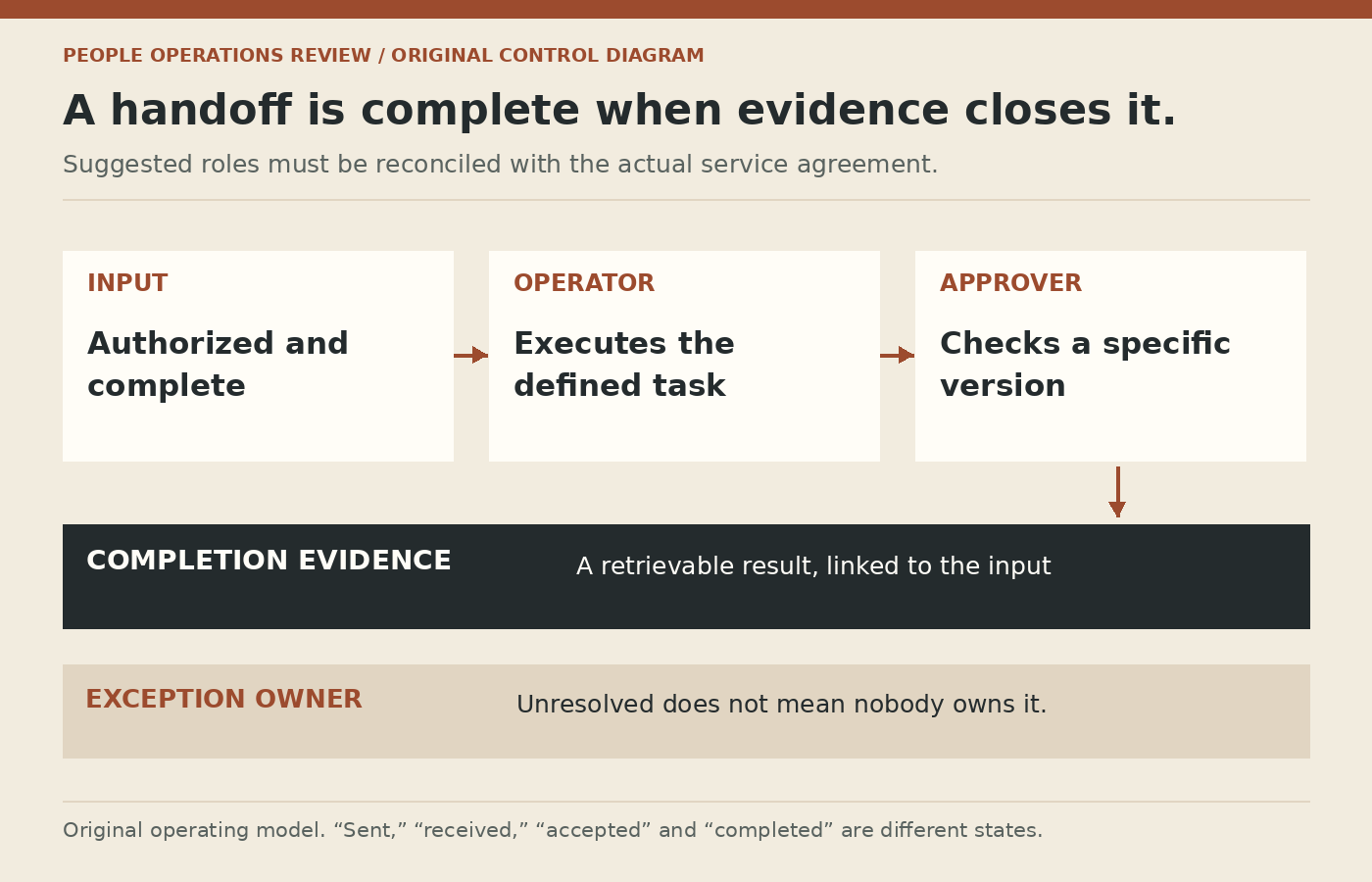
| Field | Fictional assignment | Acceptance question |
|---|---|---|
| Input | Manager submits authorized change and effective date | Is the source complete and authentic? |
| Operator | Designated payroll administrator enters it | Which run and version contain the change? |
| Approver | A separately authorized reviewer checks it | Does entered data match the approved request? |
| Evidence | Change record linked to reviewed register | Can the reviewer retrieve both later? |
| Exception | Payroll lead coordinates an unresolved mismatch | Who decides whether to reprocess or use another approved path? |
Choose workstreams that cross organizational boundaries
Start with the places where a document or decision leaves one team. Time approval to payroll input, election to carrier record, payroll output to general ledger, incident report to insurer and termination to access removal are all useful candidates. A diagram of one person’s entire job is less helpful than a few rows that expose uncertainty between people.
For each handoff, distinguish “sent,” “received,” “accepted” and “completed.” A file may reach an inbox without being accepted for processing. A successfully uploaded record may later be rejected. Require the status that actually means the downstream obligation has been addressed, and keep unresolved items visible.
Run the absent-person test
Use an invented case: a pay change arrives after the ordinary cutoff while the normal approver is away. Ask each participant to explain the next step without consulting the other participants first. Compare the answers. If one person expects a provider to decide and another expects employer authorization, the row lacks a decision owner.
Then test evidence retrieval. Ask a colleague who was not involved to find the approved input, final output and exception decision from the record index. If the colleague can find only an email saying “done,” the map may define activity without proving outcome.
Record contradictions instead of smoothing them over
Keep an issue register with the disputed step, conflicting descriptions, source documents, interim handling and required decision. An implementation call can reveal a useful clarification, but material obligations may need formal review or amendment. Have an authorized reviewer decide how to reconcile operational instructions with the contract.
For benefit-plan relationships, DOL’s fiduciary guide stresses identifying responsibilities and monitoring service providers. A broad outsourcing label does not remove the need to understand the relevant duties. This article supplies a project method, not a finding about who is a fiduciary under your plan.
Keep the map small enough to maintain
Begin with high-consequence workstreams and expand only when the detail changes an action. Link the current map to its source procedures rather than copying every instruction into cells. At renewal or after a platform change, review the rows affected by the change and record what was tested again.
The local comparison below can help you inspect up to three example workstreams. Its suggested roles and evidence are planning prompts, not your provider’s assignment. No employee details are needed.
RESPONSIBILITY WORKBENCH
Compare up to three operational handoffs
These are editorial discussion prompts. Actual responsibilities depend on the executed agreement, plan documents, applicable rules and the facts. A provider relationship does not establish that every employer duty has transferred. No selection makes a legal or contractual assignment.
All workstream notes and sources
These server-rendered records stay available without JavaScript.
Time and payroll inputs
- Business input
- Name who approves source hours, rates and changes
- Provider handoff
- Who accepts the input file, rejects exceptions and confirms the version used?
- Review and approval
- Identify a reviewer and authorized approver in your actual agreement and operating procedure; do not assume that preparation includes approval.
- Evidence to retain
- Approved source version, exception resolution, preview approval and processed totals
- Exception route
- Name the business owner, verified provider contact and backup; agree what happens when evidence is missing or late.
- Boundary
- A provider may process data without observing worksite hours; federal/state responsibilities depend on facts and arrangement; exact assignment is agreement dependent.
- Public background source
- Recordkeeping and Reporting (new tab)
Federal employment taxes
- Business input
- Identify the contracting legal entity and tax arrangement
- Provider handoff
- Which authorization, EIN and return arrangement apply, and what evidence can the client receive?
- Review and approval
- Identify a reviewer and authorized approver in your actual agreement and operating procedure; do not assume that preparation includes approval.
- Evidence to retain
- Executed agreement, applicable IRS authorization/reporting agreement and arrangement-specific filing evidence
- Exception route
- Name the business owner, verified provider contact and backup; agree what happens when evidence is missing or late.
- Boundary
- CPEO treatment is specific; customer EFTPS visibility differs when deposits use a CPEO EIN; exact assignment is agreement dependent.
- Public background source
- CPEO customers: What you need to know (new tab)
Benefit enrollment handoffs
- Business input
- Assign who approves eligibility data and documents employment changes
- Provider handoff
- Who transmits elections, confirms carrier acceptance and owns unresolved discrepancies?
- Review and approval
- Identify a reviewer and authorized approver in your actual agreement and operating procedure; do not assume that preparation includes approval.
- Evidence to retain
- Data transmission receipt, acceptance or rejection report, effective-date confirmation and premium reconciliation
- Exception route
- Name the business owner, verified provider contact and backup; agree what happens when evidence is missing or late.
- Boundary
- An election record or payroll deduction does not by itself prove carrier enrollment; plan terms and named administrator govern; exact assignment is agreement dependent.
- Public background source
- Plan Information (new tab)
Administrative access
- Business input
- Approve which staff need which permissions and who removes them
- Provider handoff
- What role options, access logs and revocation evidence can the service provide?
- Review and approval
- Identify a reviewer and authorized approver in your actual agreement and operating procedure; do not assume that preparation includes approval.
- Evidence to retain
- Named approval, least-needed role, current access review and departure revocation record
- Exception route
- Name the business owner, verified provider contact and backup; agree what happens when evidence is missing or late.
- Boundary
- This tool does not test a provider's controls or grant account access; exact assignment is agreement dependent.
- Public background source
- Protecting Personal Information: A Guide for Business (new tab)
Worksite safety and incident handoffs
- Business input
- Name the worksite hazard owner and immediate incident-response lead
- Provider handoff
- Which training, reporting, claims or loss-control services are included, and what remains with the worksite?
- Review and approval
- Identify a reviewer and authorized approver in your actual agreement and operating procedure; do not assume that preparation includes approval.
- Evidence to retain
- Site-specific safety plan, training record, reporting route and handoff acknowledgement
- Exception route
- Name the business owner, verified provider contact and backup; agree what happens when evidence is missing or late.
- Boundary
- Outsourced assistance is not proof that all OSHA or state insurance obligations transferred; exact assignment is agreement dependent.
- Public background source
- Worker Rights and Protections (new tab)
Service exit and records
- Business input
- Name an owner for continuity, retention decisions and the receiving provider
- Provider handoff
- Which records, formats, dates and reconciliation reports will be delivered on termination?
- Review and approval
- Identify a reviewer and authorized approver in your actual agreement and operating procedure; do not assume that preparation includes approval.
- Evidence to retain
- Export specification, sample validation, outstanding-item list and accepted final handover
- Exception route
- Name the business owner, verified provider contact and backup; agree what happens when evidence is missing or late.
- Boundary
- Contract, legal retention duties and data-minimization needs must be checked; this tool cannot set a universal retention period; exact assignment is agreement dependent.
- Public background source
- Protecting Personal Information: A Guide for Business (new tab)
Public background sources checked 2026-09-30. This comparison uses fixed public-source editorial examples. Selections are not submitted or saved by the package. No employee information is requested.
Use the launch acceptance gates to decide when the map has enough evidence to support a transition, and the service-review record to test whether agreed handoffs continue to work.