In this guide
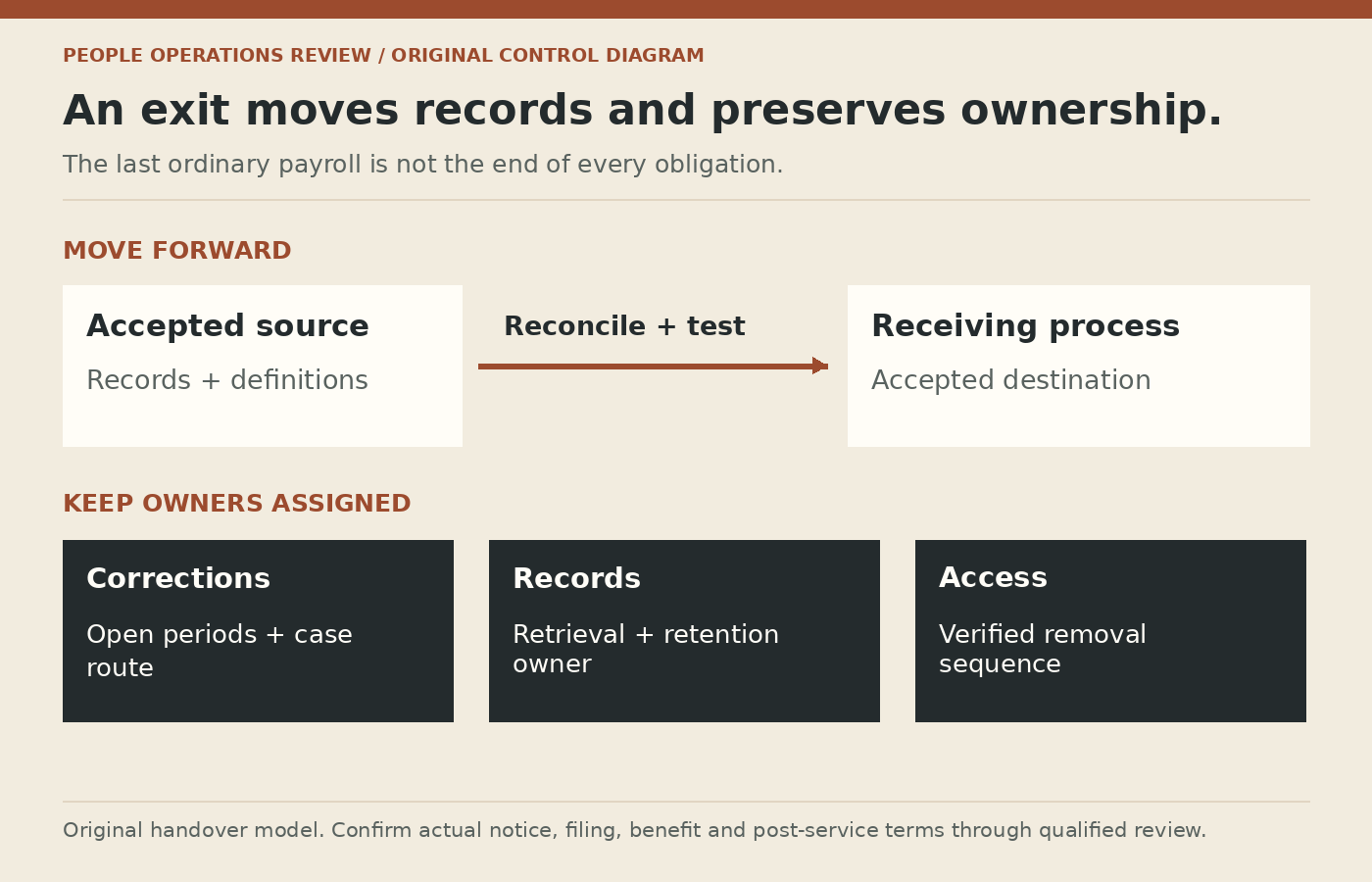
Plan the exit while the current relationship is working. Establish what records can be obtained, in what format, for which periods, at what cost if any and for how long after service ends. An orderly exit needs both a receiving process and a record of obligations that continue after the last ordinary payroll.
This guide does not recommend terminating Resourcing Edge or any other provider. It supplies an original transition-control framework. Your agreement, plan arrangements and applicable requirements must be reviewed by the appropriate professionals before notice or termination decisions.
Separate the dates
The contract termination date, last payroll processed, final pay date, benefit transition date, access end date and last correction-service date may differ. Put them on one coordinated calendar and identify which are confirmed. Do not assume that one “end date” covers every service.
Record required notice, the authorized recipient and how receipt is established from the actual agreement. This publication does not supply notice wording or interpret termination charges. Ask the responsible reviewer to identify the controlling provisions and their operational consequences.
Test exports before relying on them
Request an authorized sample or supported description of the records you will receive. Check field definitions, population, period, file format, identifiers, attachments and historical versions. A report that looks complete on screen may not contain the data required by the receiving process.
Have the receiving team demonstrate that it can read and reconcile the export through an approved test. Retain the mapping and acceptance results. Do not wait until old access disappears to discover that a needed effective date or correction history was absent.
Build a residual-obligation register
| Area | Question to resolve | Closure evidence |
|---|---|---|
| Corrections | Who handles an error found after service ends? | Confirmed route, scope and authorized result |
| Tax/filing matters | Who owns each period and any later notice? | Reviewed allocation and contact record |
| Benefit administration | Which downstream events remain open? | Accepted transition and resolved exceptions |
| Records | How can authorized reviewers retrieve history? | Tested repository and access ownership |
| Security | Which accounts, integrations and permissions must end? | Verified removal and retained authorized access |
The IRS CPEO customer guidance identifies Form 8973 as the reporting mechanism for the beginning and ending of covered CPEO contracts. Have the responsible tax professionals confirm the required handling for your actual arrangement; a commercial termination email alone is not the whole tax-administration process.
Preserve the chain across providers
For a fictional midyear transition, the old provider holds accepted runs through one period and the receiving provider begins the next. The employer needs a reconciled boundary: which year-to-date amounts transfer, which records remain historical and which party handles later corrections to each period.
Record how a correction discovered during handover will reach both relevant parties. Otherwise, an adjustment made to the source after export may never reach the destination. Use a controlled freeze or incremental-change process agreed by the parties, with a clear record of the accepted final version.
Close access in the right sequence
Coordinate exports, retrieval testing and access removal. Retaining broad administrative access indefinitely is not a good substitute for a proper records plan. Removing every account before records are accepted can also create avoidable problems. Have security and records owners approve the intended sequence.
Identify service accounts, integrations and delegated users in addition to ordinary staff logins. Confirm what data remains with each party and what deletion or retention obligations actually apply. Do not promise provider-side deletion based only on removing a local user account.
Communicate the practical change
Workers and managers may need to know which authorized resource handles questions for each period and when an old access route changes. Keep that communication accurate, accessible and limited to confirmed facts. Avoid universal claims that all historical documents will remain available forever.
Do not send employee data to a new provider merely because it appears in an exit plan. Use the organization’s approved transfer process and the permissions required for that recipient and purpose. This site does not accept uploads or arrange data transfers.
Define completion
Close the transition only after records are accepted, the first receiving workflow is reviewed, residual items have owners and access changes are verified. Some items may appropriately remain open; show them rather than treating the last invoice as proof of complete closure.
The migration controls and first-payroll acceptance pack provide the receiving side of the same transition. Keep the old and new evidence connected so the organization can answer a later question without reconstructing the handover from scattered emails.