In this guide
- Gate 1: the work has owners
- Gate 2: the data has been reconciled
- Gate 3: authorized people can do the required work
- Gate 4: a representative rehearsal is accepted
- Gate 5: exceptions and recovery have owners
- Use the readiness check as an agenda
- Distinguish a launch blocker from a manageable open item
- Method and boundaries
- Source record
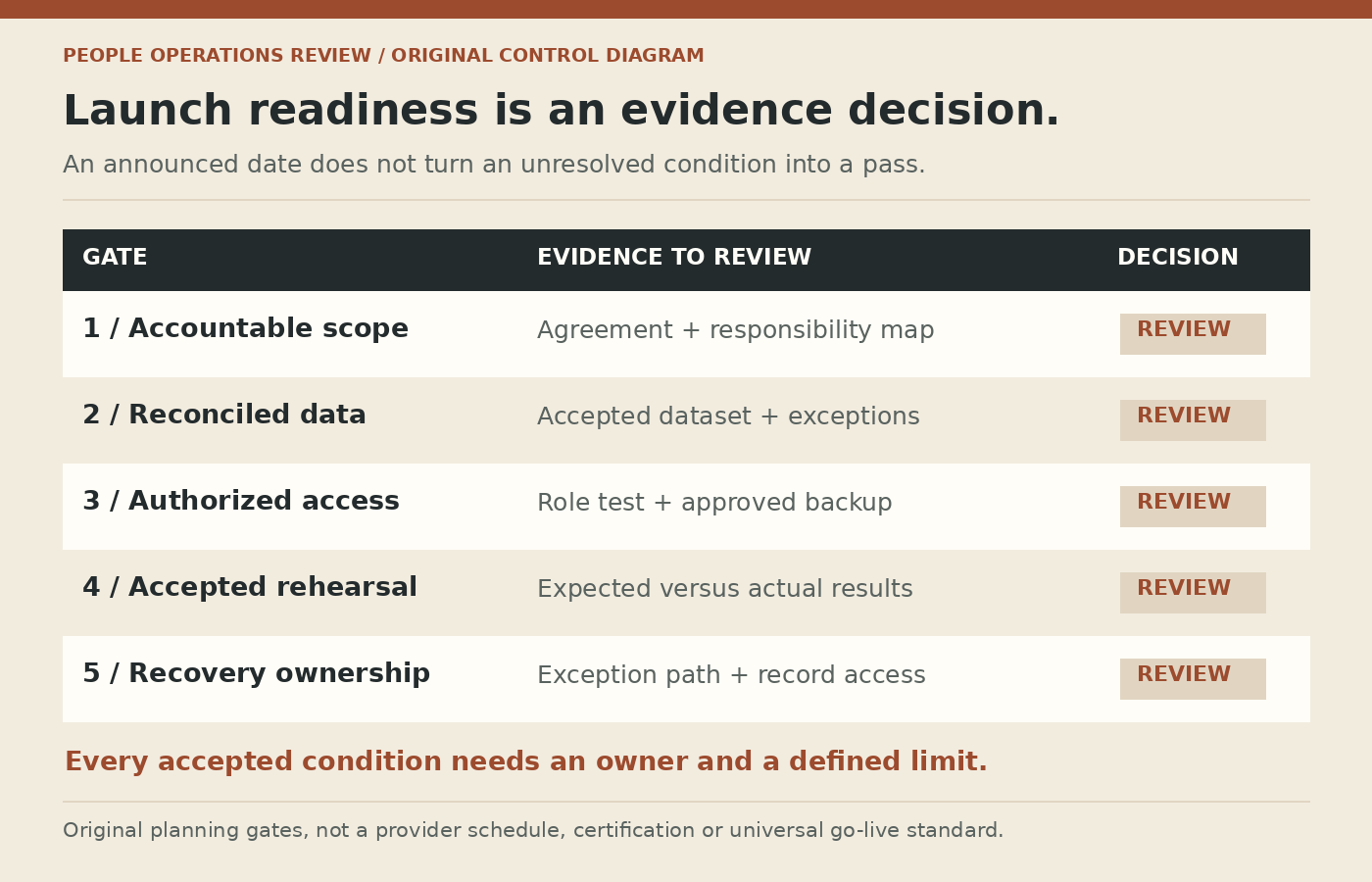
A launch date is a target; an acceptance gate is a decision backed by evidence. Before changing an HR or payroll arrangement, define what must be true for the transition to proceed and who can make that decision. A project plan full of completed meetings can still leave a payroll approval or benefit handoff untested.
This framework is an original employer-side planning method. It does not describe a required Resourcing Edge implementation sequence. Confirm your assigned platform and supported procedures with the provider: the Resourcing Edge public homepage and OneDigital PEO page named different platform experiences on our review date.
Gate 1: the work has owners
Before loading records, resolve the contracting entity, service scope and internal responsibilities. Identify a project decision-maker, operational leads and backups. Review the first pay date, benefit effective dates and dependencies with the relevant parties; do not derive timing from a generic online checklist.
Evidence might be an approved scope record, current contact roster and responsibility map. A hold condition could be a critical task assigned only to “the team,” or an unresolved disagreement about who supplies a required input. A meeting invitation does not resolve that disagreement.
Gate 2: the data has been reconciled
Document the source of truth, field definitions, effective dates and approved transformations. Reconcile record counts and control totals, then investigate differences. Totals alone cannot prove that each record is correct, so include targeted checks of high-consequence fields and unusual cases.
The data-migration control guide distinguishes missing, duplicated and transformed records. Acceptance should state which dataset and version were reviewed. Replacing a file after acceptance means the affected checks must be repeated.
Gate 3: authorized people can do the required work
Use role-based tests with fictional or appropriately protected test data. Confirm the intended operator can prepare the task, the approver can review it and an unauthorized role cannot perform the restricted step. Include backup access, recovery channels and removal of temporary implementation permissions.
Do not ask staff to share passwords to make the rehearsal easier. CISA recommends prioritizing multifactor authentication for administrative and sensitive-data access. The exact available controls must be verified in the assigned product and organizational configuration.
Gate 4: a representative rehearsal is accepted
Choose a rehearsal that tests the actual work: ordinary time, a newly effective rate, a deduction change, an unusual adjustment and downstream accounting output where relevant. Define expected results before inspecting the output. If the test case is invented, label it; if using production-derived information, follow your authorized security process.
Keep the input version, expected result, actual result, reviewer and resolution for each mismatch. Agree how the provider’s test environment differs from live processing. A successful demonstration may prove the sequence but not prove bank funding, carrier acceptance or live permissions.
Gate 5: exceptions and recovery have owners
Ask what happens if a critical file arrives late, an approver is unavailable or a downstream recipient rejects a record. Identify permitted alternatives, decision authority and communication channels. Establish what must be retained from the previous arrangement and how it will be retrieved if access ends.
A rollback plan is not a promise that every action can be undone. Once funds, filings or coverage records are transmitted, correction may require a different process. Describe the recovery path with the parties who actually control it and do not assume that returning to an old system restores every external state.
Use the readiness check as an agenda
The local tool asks about evidence categories, not employee records. “Unknown” and “not yet” produce questions to resolve. It does not certify readiness or add up legal compliance. A decision-maker still needs to review the consequences of every outstanding item.
LOCAL EVIDENCE CHECK
Which launch decisions still need evidence?
Choose a status for each editorial review gate. This produces a discussion list, not a compliance assessment or permission to launch. Select “Not applicable, with rationale” only after an accountable reviewer has documented why the gate is outside scope. Do not enter employee data, account details or confidential documents.
A current service schedule, exclusions list, and named owner for retained work.
A responsibility map naming input owner, preparer, reviewer, approver, and escalation contact.
An approved mapping specification and reconciliation record using authorized, securely handled data.
An access register showing who can view, change, approve, export, and administer, plus a removal process.
A first-payroll acceptance record, reconciliation findings, open exceptions, and accountable sign-off.
A confirmation trail covering elections, eligibility, carrier or plan receipt, and the route for unresolved discrepancies.
An escalation tree, provider contacts verified through established channels, and a tabletop record.
A documented export and access plan, retention owners, delivery format, and a tested sample export.
All eight gates begin as unknown. Review the evidence descriptions above, then build your list.
Answers remain in this page’s memory. This package does not submit or save them. A browser may restore form values after navigation. Reset clears this worksheet only. Cookie choices control optional article reading positions, not these answers.
Record the launch decision with conditions, named owners and the evidence version reviewed. After the first live run, complete the acceptance pack and compare observed results with the rehearsal. That closes the transition with evidence rather than a celebratory announcement alone.
Distinguish a launch blocker from a manageable open item
Make that distinction before the final readiness meeting. A blocker is a condition the authorized decision-maker has determined must be resolved before the relevant action. A manageable open item has an accepted interim process, an owner and a defined limit. Neither label should be assigned merely to protect the announced date.
For example, an untested report layout may be manageable if the underlying accepted data and a usable alternative report are available. An unknown approval authority for the first payroll is a different kind of problem. These are illustrative judgments, not universal classifications; the organization must evaluate the actual consequence.
Use a decision record with the evidence presented, the options considered and the authorized choice. If the team accepts a limitation, explain what that acceptance covers and what remains prohibited or pending. A broad “go” should not be interpreted as permission to ignore an unrelated security or funding requirement. Review the conditions after launch so a temporary workaround does not quietly become the permanent process.