01 / PROVIDER DECISIONS
Choose the work, then evaluate the arrangement.
Compare retained responsibilities, normalize a quote, review security evidence and preserve a usable exit route.
THE EMPLOYER-SIDE MANUAL
Independent. Public-source. Practical.
PEOPLE OPERATIONS REVIEW · INDEPENDENT EMPLOYER EDITION
Evidence, handoffs, and decisions for employer-side HR.
Work through provider diligence, payroll controls and transition decisions with original examples and a clear record of what is still unknown.
Independent U.S. editorial publication. No employee accounts, payroll processing or provider support.
REPORTED LEAD / SEPTEMBER 30, 2026
The Resourcing Edge homepage currently points to PrismONE and older PrismHR routes. OneDigital’s PEO page still names re360. The practical response is to verify the platform assigned to your organization and the scope in your agreement.
Our guides therefore focus on evidence and responsibilities rather than invented private menu instructions. Build the exact-entity diligence record before relying on a brand-level credential.
01 / PROVIDER DECISIONS
Compare retained responsibilities, normalize a quote, review security evidence and preserve a usable exit route.
02 / PAYROLL CONTROLS
Reconcile data, give late changes a route and connect each run to an acceptance record.
03 / PEOPLE & RISK
Track benefit records, administrator capabilities, location changes and safety responsibilities.
WORKBENCH / COMPARE UP TO THREE
Compare suggested inputs, owners, checks, evidence and escalation routes. These are planning examples to reconcile with your agreement.
RESPONSIBILITY WORKBENCH These are editorial discussion prompts. Actual responsibilities depend on the executed agreement, plan documents, applicable rules and the facts. A provider relationship does not establish that every employer duty has transferred. No selection makes a legal or contractual assignment. These server-rendered records stay available without JavaScript. Public background sources checked 2026-09-30. This comparison uses fixed public-source editorial examples. Selections are not submitted or saved by the package. No employee information is requested.Compare up to three operational handoffs
All workstream notes and sources
Time and payroll inputs
Federal employment taxes
Benefit enrollment handoffs
Administrative access
Worksite safety and incident handoffs
Service exit and records
WORKBENCH / PREPARE A DECISION
The readiness check turns eight evidence questions into a review agenda. It does not collect employee records or produce a compliance score.
LOCAL EVIDENCE CHECK
Choose a status for each editorial review gate. This produces a discussion list, not a compliance assessment or permission to launch. Select “Not applicable, with rationale” only after an accountable reviewer has documented why the gate is outside scope. Do not enter employee data, account details or confidential documents.
A current service schedule, exclusions list, and named owner for retained work.
A responsibility map naming input owner, preparer, reviewer, approver, and escalation contact.
An approved mapping specification and reconciliation record using authorized, securely handled data.
An access register showing who can view, change, approve, export, and administer, plus a removal process.
A first-payroll acceptance record, reconciliation findings, open exceptions, and accountable sign-off.
A confirmation trail covering elections, eligibility, carrier or plan receipt, and the route for unresolved discrepancies.
An escalation tree, provider contacts verified through established channels, and a tabletop record.
A documented export and access plan, retention owners, delivery format, and a tested sample export.
All eight gates begin as unknown. Review the evidence descriptions above, then build your list.
Answers remain in this page’s memory. This package does not submit or save them. A browser may restore form values after navigation. Reset clears this worksheet only. Cookie choices control optional article reading positions, not these answers.
ORIGINAL COMPARISON / FICTIONAL FEES
With 40 employees, an invented $95 monthly per-person fee equals $45,600 annually. An invented 1.8% payroll fee equals $43,200 on $2.4 million of payroll, but $50,400 on $2.8 million. Identical scope and a fixed workforce are assumptions; these are not provider prices.
SOURCE-BASED PATHWAY
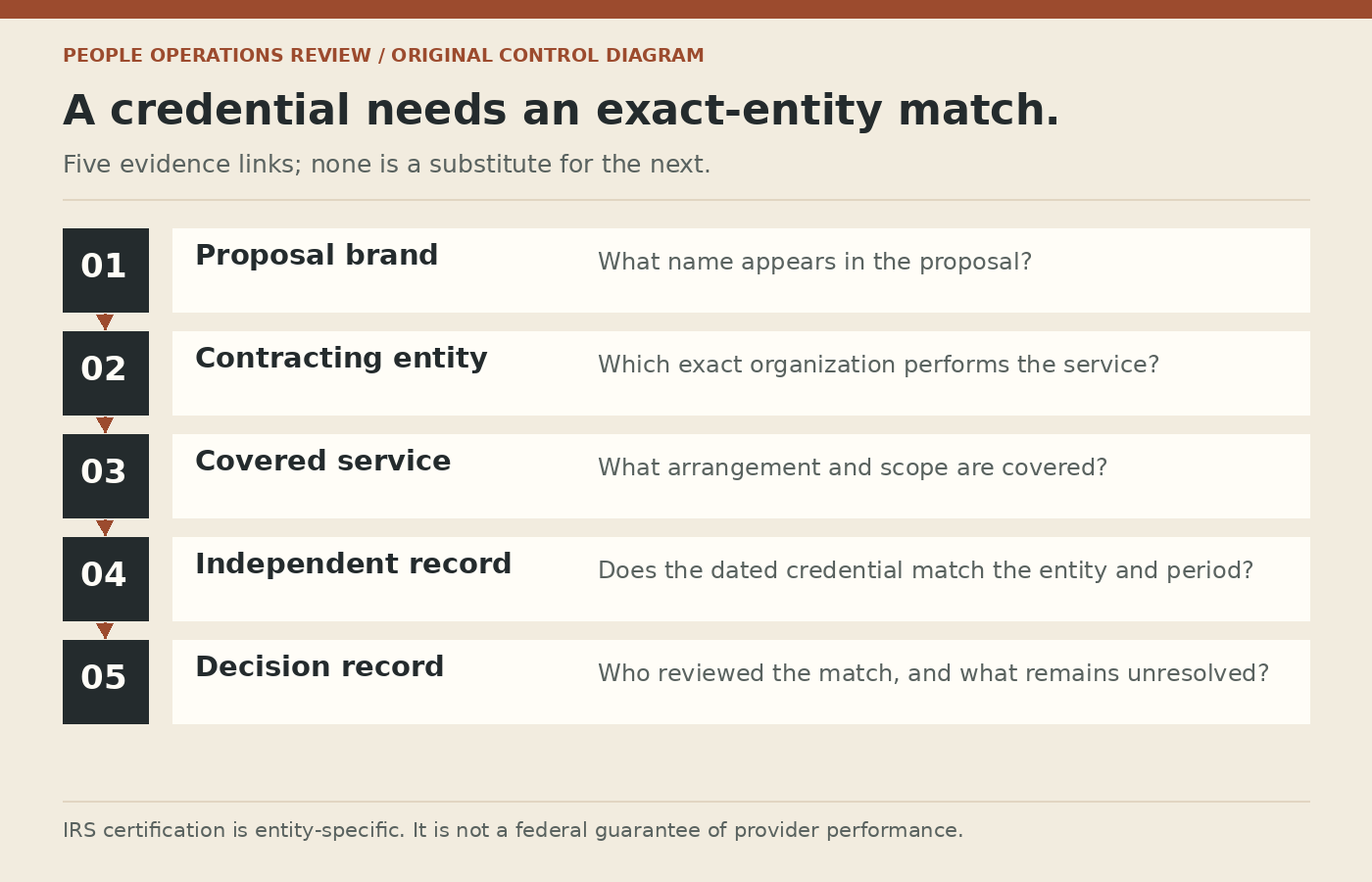
IRS certification guidance defines the program’s requirements. A credential does not replace your contract review or the evidence for each operating handoff.
THE OPERATING MANUAL
Each guide answers a different employer-side question, from a contract responsibility map to a tested records handover.
19 reviews
Provider Decisions
Build an exact-entity evidence record for a Resourcing Edge proposal, with certification scope, source dates and unresolved questions.
Read the review : Check the Contracting Entity Before Relying on a CredentialProvider Decisions
Compare proposed PEO, administrative and payroll services by retained work, evidence access and transition needs rather than labels.
Read the review : Choose a Service Model by the Work You KeepProvider Decisions
Translate agreed scope into inputs, operators, approvers, evidence and exception routes without pretending a checklist changes the contract.
Read the review : Turn the Service Agreement into an Operating MapProvider Decisions
Compare fictional percentage and per-employee fees on the same workforce and period, then surface excluded services and transition costs.
Read the review : Normalize a PEO Quote Before Comparing PricePayroll Controls
Use evidence-based go-live gates for scope, data, access, payroll rehearsal, benefit handoffs and recovery without inventing a provider schedule.
Read the review : Set Acceptance Gates for an HR Provider LaunchPayroll Controls
Use a field map, exception register and balanced control totals to test a payroll migration without treating a successful upload as acceptance.
Read the review : Reconcile the Data Before It Becomes PayrollPayroll Controls
Build a payroll decision calendar that separates input, review, approval and funding dependencies and gives late changes an accountable route.
Read the review : Design a Payroll Cutoff That Includes ExceptionsPayroll Controls
Link authorized payroll changes to effective dates, entered values, reviewed versions and final output with a practical exception trail.
Read the review : Make Every Pay Change TraceablePayroll Controls
Assemble the inputs, reconciliations, approvals and unresolved decisions needed to accept a first live payroll run after a provider transition.
Read the review : Build a First-Payroll Acceptance PackPayroll Controls
Plan verified communication, decision authority and duplicate-prevention controls for a payroll funding problem without assuming banking cutoffs or payment options.
Read the review : Prepare a Payroll Funding Exception PlaybookPeople & Risk
Track benefit changes through transmission, acceptance and reconciliation so an employer can find unresolved handoffs without making coverage promises.
Read the review : Close the Gap Between an Election and CoverageProvider Decisions
Build a vendor security evidence request that distinguishes report scope, customer controls, incident terms and unanswered questions.
Read the review : Ask for Security Evidence You Can Actually EvaluatePeople & Risk
Review who can view, change, approve, export and administer HR/payroll records, with temporary-access expiry and evidence of removal.
Read the review : Review Administrator Access by CapabilityPeople & Risk
Run a fictional payroll incident exercise that tests decision authority, evidence preservation, provider contacts and accurate communications.
Read the review : Rehearse a Payroll Incident Before One HappensPeople & Risk
Coordinate effective dates, payroll setup, benefits, risk and records when a worker or worksite changes location, without applying a one-state legal shortcut.
Read the review : Control the Operational Change When Work Moves StatesPayroll Controls
Create a year-end evidence index that connects payroll totals, corrections, filing responsibilities and record access without inventing universal deadlines.
Read the review : Make Year-End Payroll Evidence RetrievableProvider Decisions
Build a provider review from agreed commitments, correctly defined metrics and documented exceptions instead of unsupported industry benchmarks.
Read the review : Measure Provider Service Without Inventing an SLAProvider Decisions
Prepare service-end dates, export acceptance, correction ownership and access closure before an HR/payroll provider transition.
Read the review : Plan a Provider Exit While Records Are Still AvailablePeople & Risk
Map worksite safety actions, provider support and claims communication so a service relationship does not leave practical responsibilities unassigned.
Read the review : Define Safety and Claims Handoffs Before an IncidentRESPONSIBILITY MAP
| Question | Who to ask | Evidence | Limit |
|---|---|---|---|
| Contract scope or a disputed handoff | Named provider relationship owner and the business’s contract owner ↗ | Use the executed agreement, service schedule and documented change record. | Marketing text cannot settle a particular agreement. |
| Federal CPEO certification status | IRS public CPEO records ↗ | Compare the exact legal entity and listing status at the time of your check. | Certification has a defined federal tax scope; it is not a general endorsement. |
| Benefit coverage and plan rights | Plan administrator, carrier and official plan documents ↗ | Use the applicable plan and confirmed enrollment records. | A payroll deduction or submitted election alone is not proof of coverage. |
| Workplace hazard or urgent safety incident | Worksite safety owner and appropriate emergency response ↗ | Follow verified workplace emergency procedures; use public OSHA guidance for background. | Do not wait for an editorial worksheet or routine service review. |
| An error in this publication | Publication editor | Provide the article URL and a public source supporting the correction. | Do not send private workforce records or credentials. |
External links provide public background and leave this independent publication. They are not a private support channel or a substitute for your organization’s verified contacts.
PUBLIC VIDEO REFERENCES
Two relevant references link to their publishers. No player loads here. Source-page checks do not establish playback; the on-demand webinar may require registration on the provider’s site.
OSHA / U.S. Department of Labor
Official public video reference
Companion to owner-side safety support/handoff planning and small-business resources
Open video reference at OSHA / U.S. Department of Labor (opens in a new tab)
Actual OSHA page read; title/date/duration and linked YouTube ID verified. YouTube fetch failed; no playback tested. Playback not tested; captions not verified.
OneDigital
Vendor-authored on-demand webinar reference
Vendor-authored on-demand webinar on PEOs and benefit/workforce costs; review its claims critically alongside an actual quote
Open video reference at OneDigital (opens in a new tab)
Official source page explicitly labels named item On-Demand Webinar. ON24 player/destination could not be fetched. This is a source-page-verified webinar reference, not an accessible-player or playback verification. Playback not tested; captions not verified.
EDITORIAL METHOD
Official sources support specific facts. Our workflows and fictional examples help readers prepare a decision without pretending to audit a private account or replace legal, tax, benefits or security professionals.