In this guide
- Start with one common scenario
- Define the denominator before calculating
- Separate pass-through amounts from service fees
- Include work that remains inside the organization
- End with a price range of conditions, not false certainty
- Check the invoice design before signing off on the model
- Method and boundaries
- Source record
Put every quote on the same workforce, period and service scope before comparing totals. A percentage of payroll and a monthly amount per employee can both be clear prices while measuring different things. Neither tells you the total cost until the billing base, inclusions, exclusions and changes are understood.
This page uses invented prices solely to show the method. They are not Resourcing Edge rates, market averages or estimates of what an employer will be offered. OneDigital’s public service descriptions provide context for differing scopes; they do not supply the hypothetical rates below.
Start with one common scenario
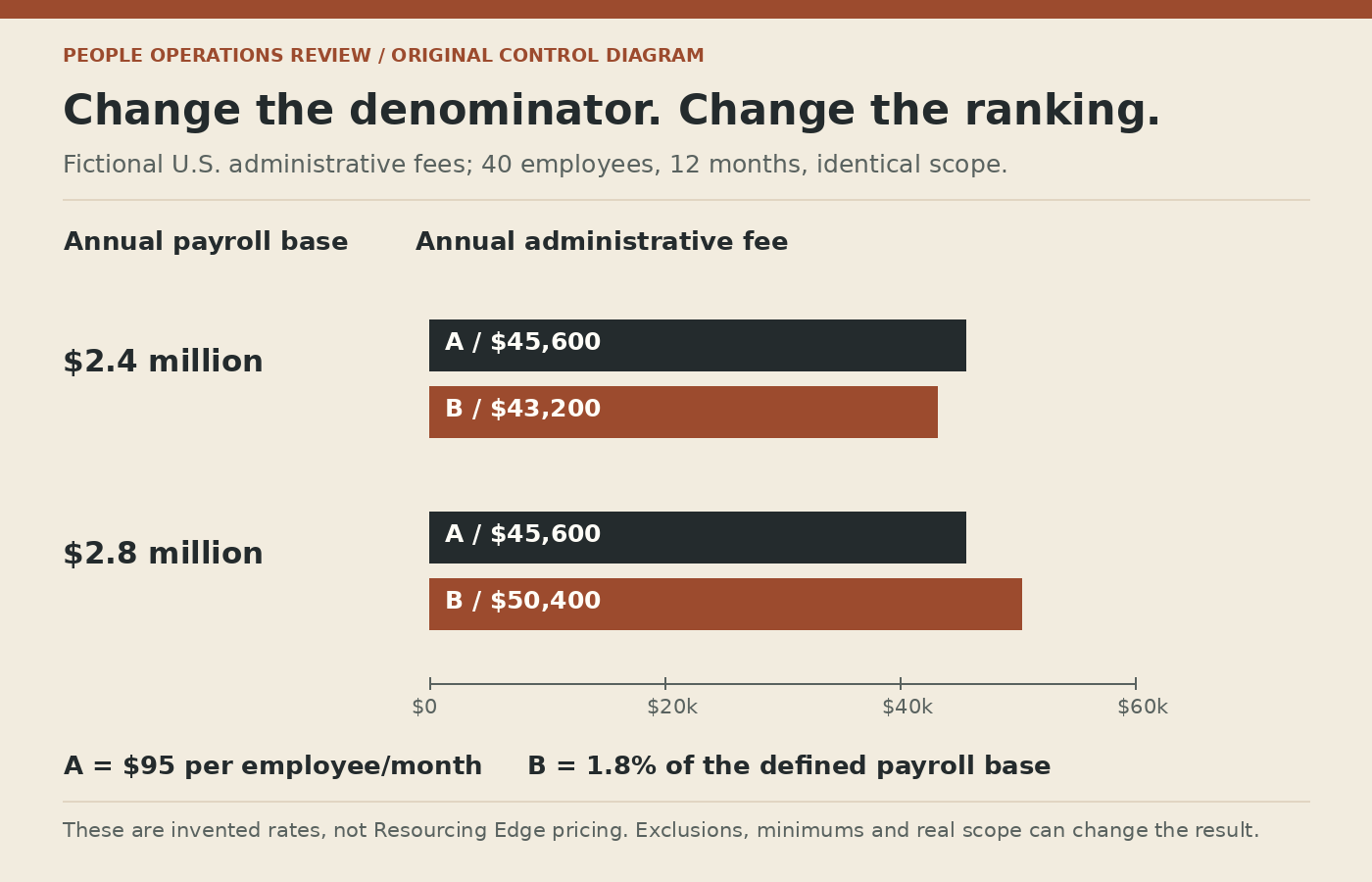
Assume 40 employees for all 12 months and $2,400,000 of annual payroll in the fee base. Fictional Quote A charges an administrative fee of $95 per employee per month. Fictional Quote B charges 1.8% of the defined payroll base. Assume, for this arithmetic only, that both cover identical administrative work and that no minimums or other fees apply.
| Measure | Quote A | Quote B |
|---|---|---|
| Billing basis | $95 × 40 employees × 12 months | 1.8% × $2,400,000 payroll |
| Annual fee in this scenario | $45,600 | $43,200 |
| Difference | A is $2,400 higher | B is $2,400 lower |
| At $2,800,000 payroll, same headcount | $45,600 | $50,400 |
| Difference in higher-payroll case | A is $4,800 lower | B is $4,800 higher |
The ranking reverses when payroll increases while headcount stays fixed. That is a property of these invented formulas, not a prediction of provider pricing. The break-even payroll for these assumptions is $45,600 divided by 0.018, or about $2,533,333. Real quotes can have tiering, minimums and base definitions that make this simple threshold inapplicable.
Define the denominator before calculating
For a per-employee fee, ask which employees are billable, when counts are measured and how a partial month or inactive status is handled. For a payroll percentage, ask which compensation enters the base, which reimbursements or special payments are excluded, and how corrections affect charges. “Payroll” is not precise enough for a price comparison.
Keep one row for the quoted rule, one for the provider’s written clarification and one for the model’s treatment. If you do not know how an item is charged, label it unknown. Entering zero makes an unresolved cost look like a confirmed free service.
Separate pass-through amounts from service fees
Use distinct sections for administrative charges; benefit-related costs; insurance-related charges; taxes; implementation; special processing; integrations; and exit support. The categories are prompts, not a claim that any particular provider charges each one. Ask which amounts can change, who controls the change and how the employer receives notice.
Do not count the same payroll tax or premium twice simply because it appears on a bundled invoice and in your internal budget. Equally, do not call a bundled line item “all-inclusive” until the actual exclusions have been checked. Have finance validate how each line maps to your accounting model.
Include work that remains inside the organization
If one proposal requires more manual reconciliation, assign realistic internal hours to that work. State the hourly cost assumption and whether it represents cash expenditure, allocated staff cost or opportunity cost. Those are different concepts. A saved staff hour does not necessarily remove an expense from the budget.
For the first year, show one-time transition effort separately from recurring expense. For a renewal, compare like-for-like periods and identify new scope. Do not spread a one-time charge over three years in one proposal while counting it entirely in year one for another.
End with a price range of conditions, not false certainty
Present a base case and the two changes most likely to alter the result, such as headcount growth and higher payroll. List unresolved billing terms alongside the result. The decision-maker should see both the arithmetic and the conditions that could invalidate it.
The next useful artifact is the operating map: a lower quoted fee is less informative if a necessary task has no owner. Revisit the assumptions during the service review using actual invoices and approved scope, without turning this editorial exercise into a vendor endorsement.
Check the invoice design before signing off on the model
Ask for a redacted sample or illustrative invoice that shows how the proposed charges would appear. Match its line items to the comparison model. The goal is to learn whether the employer can later distinguish a price change, population change, one-time charge and correction without reconstructing the invoice from scratch.
In a fictional first invoice, the total could exceed the modeled monthly amount because the billable population differs from the assumed population. That does not establish an overcharge. Compare the agreed counting rule, the dated population and the invoice calculation. If the rule remains unclear, the model’s apparent precision is premature.
Write down the evidence needed for a future dispute or clarification: applicable schedule, population basis, period and calculation. This makes quote diligence useful after selection. It also avoids treating a lower headline rate as a saving before the employer knows how the actual bill can be reviewed.